

In commercial development, permits and regulations are the legal approvals and safety rules that keep a project safe, reliable, and in line with local requirements. A permit is an official “green light” from a government agency-local, state, or federal-that allows a developer to carry out a specific type of work on a property.
These rules protect the public, safeguard natural resources, and make sure a building’s structural, electrical, and mechanical systems meet current codes.
Getting through this system can feel like solving a large, detailed puzzle. Without the right approvals, a project is just drawings and ideas. Permits confirm that your plans follow zoning rules and safety laws, avoiding the confusion and danger that can come from unregulated building. For any project manager or business owner, understanding this process is the starting point for a safe, legal, and successful project.
What Are Permits and Regulations in Commercial Construction?
Why Are Permits Required for Commercial Projects?
The main reason behind the permit process is public safety. Commercial buildings can hold hundreds or even thousands of people, so structural strength and fire protection cannot be ignored. Permits confirm that each stage of work, from foundation to roof, follows strict standards. By requiring a permit, local officials can check that the design will not collapse, catch fire easily, or trap people in an emergency.
Permits also serve as quality control and legal protection for the owner. They help make sure contractors perform work that meets a basic professional standard. Having a complete record of permits is also key for insurance, bank financing, and any future sale of the property. In many areas, building without a permit can lead to large fines, legal action, or even ordered demolition of unapproved work.
Who Regulates Commercial Construction?
Control over commercial construction involves several layers of government. Locally, city or county building departments and planning boards are the primary contacts. They handle zoning, site layouts, and building codes.
In some big cities, local rules can be very specific; for example, safety of existing buildings matters as much as new ones, as shown by rules like NYC Local Law 11, which manages facade inspections and repairs to protect people on the street.
State and federal agencies also have important roles. At the federal level, the Occupational Safety and Health Administration (OSHA) sets job site safety standards to protect workers, and the Environmental Protection Agency (EPA) oversees air and water impacts. State boards may add their own rules on environmental protection or licensing for architects and engineers. These groups often must work together, since a single project may need approval from all three levels of government.
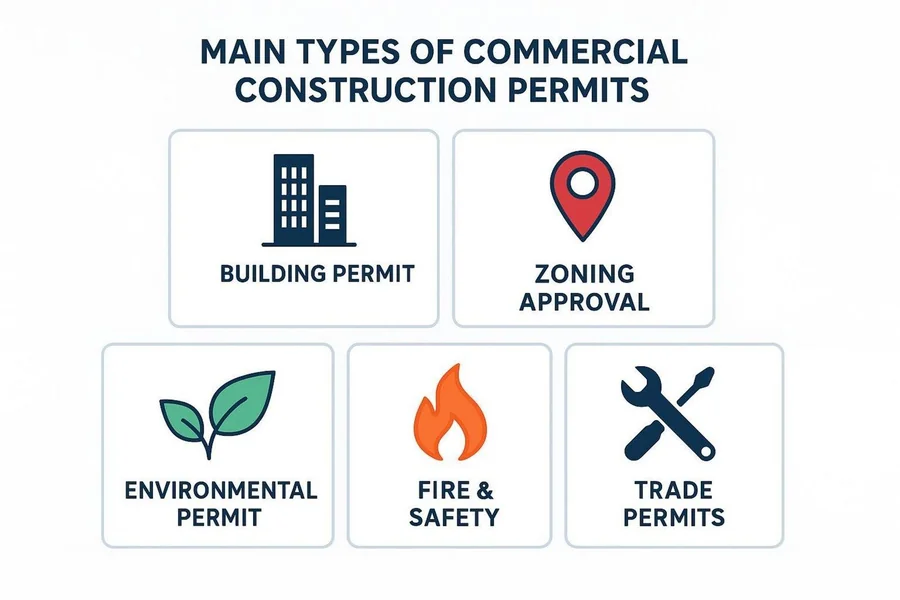
Types of Permits for Commercial Construction Projects
Building Permits
The building permit is the most common approval for commercial projects. It covers “vertical construction” from the ground up. This permit confirms that the main structure, including framing and all load-bearing parts, follows the International Building Code (IBC) or local changes to it. Whether you are starting a new office tower or doing a major remodel of a store, the building permit is the basic requirement.
This permit usually serves as an umbrella for many reviews. Officials will check architectural plans and engineering calculations to confirm the building can handle local conditions such as strong winds, heavy snow, or earthquakes. It is the clear sign that your project is legally allowed to be built.
Zoning and Land Use Approvals
Before thinking about how to build, you must confirm you are allowed to build what you want at that location. Zoning approvals make sure that the planned use-office, industrial, retail, or mixed-use-matches the city’s long-term plan. Zoning rules set limits on building height, how dense development can be, and how far buildings must be from streets and neighbors.
If a project does not fit the current zoning exactly, the process becomes more involved. The developer may need a variance or special use approval, which often includes public hearings. This review helps make sure new commercial projects do not harm neighborhood character or overload local services like roads, water, and sewers.
Environmental Permits
Modern construction is closely linked to protecting the environment. If a project affects natural areas such as wetlands, rivers, or protected land, environmental permits are required. These often focus on stormwater control-making sure rainwater from roofs and parking lots does not flood other properties or carry pollutants into local waterways.
For large projects, an Environmental Impact Assessment (EIA) may be needed. This report studies how the project will affect air quality, wildlife, noise, and nearby communities. Addressing these requirements early is important, since environmental reviews can be some of the longest steps before construction starts.
Fire and Safety Permits
Fire protection is a major concern for commercial buildings. Separate permits are needed to install or change fire systems such as sprinklers, smoke detectors, fire alarms, and fire pumps. These approvals confirm that, in an emergency, the building’s systems will work as needed to protect people and allow safe evacuation.
Inspectors also review “life safety” features: the number and width of exits, emergency lighting, use of fire-rated materials in corridors and stairwells, and whether fire trucks can reach all sides of the building. A building cannot open for use until the fire marshal or another safety official has signed off on these parts of the project.
Specialty and Trade Permits (Electrical, Plumbing, Mechanical)
While the building permit covers the shell and structure, separate “trade” permits apply to systems inside the building. Electrical permits cover wiring, panels, lighting, and power distribution. Plumbing permits address water lines, sewer connections, and gas piping. Mechanical permits deal with HVAC equipment, ventilation, and exhaust systems.
Licensed subcontractors usually apply for these permits. Each trade follows its own code and inspection stages. For example, an electrical inspector must review wiring before walls are closed with drywall, to verify proper grounding, wire sizes, and safe installation.
Accessibility (ADA) Compliance
The Americans with Disabilities Act (ADA) is a federal law that requires commercial buildings to be usable by people with disabilities. This is a legal duty, not an option, and it affects almost every part of the design. ADA standards include features such as ramps, elevators with braille and audible signals, accessible restrooms, and properly marked parking spaces.
Planning these features into the design is far cheaper than fixing problems later. Inspectors will check door widths, ramp slopes, reach ranges for hardware, and parking layouts to see that all ADA rules are followed. These requirements help make sure that all members of the public can safely enter and move through the building.
Regulatory Requirements for Commercial Construction
Federal Regulations
Federal rules focus on overall safety and fair treatment. OSHA standards set the baseline for worker protection on job sites, including fall protection, handling chemicals, and electrical safety. Ignoring OSHA rules can lead to heavy fines and stopped work.
The EPA enforces laws like the Clean Water Act, which controls how construction sites handle sediment, runoff, and certain chemicals. Federal laws also include rules about wages, overtime, and hiring practices, to help keep the construction industry safe and fair for employees.
State and Local Codes
Federal law sets the minimum level, but state and local codes provide the detailed rules for how to build. Most areas adopt a version of the International Building Code (IBC), often with local changes. For example, coastal cities may require stronger wind resistance, while earthquake-prone regions focus more on seismic design.
Local codes also cover smaller permits such as signs, fences, temporary construction trailers, and sidewalk or street closures. Keeping up with these changing local rules is a challenge, as many codes are updated on a regular schedule to reflect new knowledge and technology.
Zoning Laws and Variances
Zoning laws act as the blueprint for how a city is organized. They separate uses so that, for example, an industrial plant is not built next to a school and busy shopping centers have enough parking and road access. But because many zoning rules were written many years ago, they may not match today’s project types and design ideas.
When a project conflicts with existing zoning, the developer may request a variance. This is a formal request for an exception. To succeed, the applicant usually must show that strict enforcement of the rule causes an unfair hardship and that the change will not harm neighbors or public safety. Public meetings are common, and nearby residents can speak for or against the request.
Environmental Protection Standards
Environmental rules for buildings are becoming stricter as communities push for “green” development. Beyond basic runoff controls, many areas now require certain energy performance levels. This can involve using efficient HVAC equipment, better insulation, low-energy lighting, or renewable power sources such as solar.
Compliance may be measured using programs like LEED or local green building codes. These efforts reduce environmental impact and often lower long-term utility costs, which benefits both the planet and the property owner’s operating budget.
Step-by-Step Permit Approval Process
Initial Project Planning and Research
The process starts long before construction activity begins. The first step is detailed research on rules that apply to your site. This includes confirming the property’s zoning and checking which building, fire, and energy codes are current. Many experienced developers say a bit of early research can prevent many problems later on.
During this stage, clearly define the full scope of work. Are you constructing a new building, fitting out a shell space, or remodeling part of an existing property? The answers determine what permits are needed and which departments will review your plans.
Pre-Application Meetings
Many local governments offer pre-application or “concept” meetings, which can be extremely helpful. These meetings give you a chance to talk with plan reviewers, fire officials, and zoning staff about your idea before you submit full plans. You can identify problems early, such as a required easement or utility line in the way of your planned structure.
Being open and prepared in these meetings helps build good working relationships with staff who will later review your project. A clear, respectful presentation can often make the whole process smoother.
Preparing Permit Documentation
After you know what is required, you and your design team prepare the documents. This includes site plans, floor plans, elevations, structural calculations, and mechanical, electrical, and plumbing (MEP) drawings. These must be accurate, complete, and usually sealed by licensed professionals.
Missing or incomplete information is a major cause of delays. Details such as material types, insulation ratings, door hardware, and fire-resistance ratings must be clearly labeled. A missing stamp, unclear dimension, or inconsistent note can cause your submittal to be returned for correction.
Submitting Permit Applications
Once the documents are ready, you submit them to the appropriate departments-often through an online system, but sometimes in person. At this time, you will pay application fees, usually based on project value or size.
Your plans are then sent to multiple reviewers: building, zoning, fire, engineering, health, and sometimes others. Each group looks at different parts of the design according to its own code sections and standards.

Review and Decision by Regulatory Authorities
Next comes the review period. Officials closely examine your plans to verify compliance with all codes and ordinances. They will usually issue written “comments” or correction notices instead of an outright denial.
Your team must respond to these comments with updated drawings or clarifications. If a reviewer asks for more exits, better drainage, or changes to parking layout, the plans must be revised and resubmitted. For complex projects, this back-and-forth may repeat several times before full approval.
Permit Issuance and Fees
After all comments are resolved and every department signs off, the permit is issued. You receive a permit document or card that must be posted in a visible place on site. This shows that your project has been reviewed and authorized.
Any remaining permit fees are usually paid at this stage. These fees help cover the cost of inspections during construction. Once payment is made and the permit is posted, you can legally begin work.
Required Inspections During Construction
Approval of the permit is only one step. During construction, inspectors must verify that work matches the approved plans and codes. Inspections are scheduled at set points: foundation, framing, rough plumbing, rough electrical, mechanical systems, and final completion. Industry leaders in exterior repair, such as https://novaconstructionservices.com/, understand that maintaining high standards during these phases is critical to ensuring a building’s long-term safety and structural integrity.
You cannot move on to the next stage without passing the required inspection. Good scheduling and communication matter. If work is covered up before inspection—such as closing a wall before wiring is checked—the inspector can order that area opened again to confirm compliance.
Certificate of Occupancy and Project Closeout
When construction is complete, you request final inspections. If all systems pass and the building meets all code and zoning requirements, the city issues a Certificate of Occupancy (CO) or similar document. This confirms that the space is safe for its intended use.
With the CO in hand, you can legally move tenants in and open for business. From the regulator’s viewpoint, this step marks the official completion of the project.
What Do Inspectors Review During the Construction Process?
Structural Safety and Code Compliance
Structural inspections focus on the “skeleton” of the building. Inspectors check that materials and details match the approved drawings-for example, correct steel sizes, proper concrete strength, anchor bolts, and rebar placement. They confirm that loads are transferred properly from roof to foundation.
Inspectors also review smaller items that affect safety, such as stair dimensions, guardrail and handrail heights, and proper fastening. Every structural part must be installed as engineered to keep the building safe over its full life.
Fire Life Safety Systems
For fire protection, inspectors test alarm and suppression systems. They verify that alarms, horns, strobes, smoke detectors, and pull stations are installed correctly and that sound and light coverage reach all occupied areas. They check sprinkler coverage, water pressure, and that heads are not blocked.
They also inspect fire barriers, fire doors, and penetrations through rated walls or floors. Any gaps around pipes, ducts, or cables in fire-rated assemblies must be sealed with approved firestop materials to slow the spread of smoke and flames.
Accessibility and ADA Standards
Accessibility inspections are detailed and measurement-based. Inspectors measure ramp slopes, doorway clearances, turning spaces in restrooms, reach heights for switches, and grab bar placement. They verify curb ramps, tactile warning surfaces, and accessible path routes from parking to the main entrance.
Even small deviations from ADA dimensions can trigger corrections. The goal is to make sure people with mobility, vision, or hearing challenges can use the building independently and safely.
Environmental and Site Requirements
Site inspectors pay attention to how construction affects nearby properties and public areas. They review erosion and sediment controls, such as silt fences and inlet protection, to keep mud and debris out of streets and storm drains. They also make sure the final grading, paving, and landscaping match the approved plans.
Where projects include stormwater systems-like detention ponds, underground tanks, or bioswales-inspectors verify that they are built as designed. Proper installation helps prevent flooding and protects water quality.
Common Challenges in Navigating Permits and Regulations
Zoning Conflicts and Variances
A frequent problem arises when a project’s design conflicts with existing zoning. Issues might include building height, parking counts, setback lines, or allowed uses. Requesting a variance and presenting it to planning boards or councils can be slow and requires good legal and design support.
Neighbors may also oppose changes. Concerns can include traffic, noise, shadows, or views. Developers often need to meet with neighbors, adjust designs, or offer improvements like better landscaping or traffic controls to gain support.
Permitting Delays and Backlogs
In growing areas, building departments may be overwhelmed by volume. This can lead to long review times, even for simpler projects. Any delay in receiving permits can push back construction start dates and increase interest and holding costs.
Developers often include extra time in their schedules to account for these delays. Staying organized, responding to comments quickly, and keeping polite contact with staff can help move files along.
Changing Building Codes
Codes are updated regularly. If your project spans a code update, you may have to adjust designs to meet new rules for life safety, energy efficiency, ventilation, or structural systems. This can lead to added design work and extra cost.
Design teams must track which code edition applies and when new ones take effect. Submitting a complete permit application before a change may allow a project to follow the older code, but this depends on local policy.
Community or Neighborhood Pushback
Larger commercial projects can face strong reactions from residents. Concerns may center around traffic, noise, lighting, height, or the type of business moving in. Hearings at planning commissions or councils can delay or change a project.
Developers often see better results by meeting with community groups early, explaining the project, and listening to concerns. Adjusting design elements, adding screening or landscaping, or agreeing to certain operating limits can help reduce opposition.
Overlapping Jurisdictions
Sometimes different agencies with control over the same site have conflicting requirements. A state highway department may want one type of driveway layout, while the city has a different standard. A fire official may request door swing directions that differ from building code recommendations.
Solving these conflicts usually requires meetings or calls with representatives from each agency to agree on a solution. Good records and clear communication are key to getting a final answer everyone accepts.
Tips for Streamlining the Permitting Process
Hiring Third-Party Permit Expeditors
On large or complex projects, many teams hire permit expeditors. These specialists work full-time on permits and approvals. They know which forms are required, how each department likes submissions, and who to contact to check on status.
Though they add a cost, expeditors can reduce delays and avoid repeated rejections. They can review packages before submittal, organize responses to comments, and keep track of where each permit stands.
Engaging with Local Authorities Early
Early contact with local officials can prevent surprises later. Sharing your concept before final design helps identify major issues before you spend money on full drawings. Officials may point out zoning concerns, access issues, or utility constraints that must be addressed.
When staff feel informed and involved, they are often more willing to help find practical solutions instead of just saying “no.” This can save both time and redesign costs.
Keeping Documentation Organized
Careful document control is very helpful during permitting and construction. Many teams set up a shared digital folder with all plans, reports, permits, and comments, clearly labeled and dated. Tracking versions avoids confusion about which set of plans is current.
Quick access to documents also helps during inspections. When an inspector asks for a structural detail or engineer’s letter, being able to provide it right away creates confidence and can lead to smoother site visits.
Planning for Inspection Scheduling
Inspection schedules often fill up quickly. Instead of waiting until work is ready, contractors work backward from their construction plan and request inspector time in advance. This helps avoid idle days where crews are waiting on approvals.
Teams should also be ready with backup plans if an inspection fails. Having workers available to fix issues right away can shorten delays and keep the project on track.
Risks and Consequences of Non-Compliance
Legal Penalties and Fines
Skipping permits or ignoring code requirements can lead directly to enforcement. Building officials can issue Stop Work Orders, shutting down all activity at the site. During this time, the project still carries costs for rentals, supervision, and overhead, but no progress is made. Daily fines may also accumulate until the problem is fixed.
Severe violations can bring lawsuits or criminal charges. Owners and contractors may face loss of licenses or other long-term penalties that damage their ability to work on future projects.
Project Shutdowns and Delays
Forced shutdowns can derail business plans. If space is not ready for a tenant’s planned opening date because of permit issues, the project owner may be responsible for lost income, penalties, or relocation costs.
Delays also strain relationships with lenders. Construction loans usually have strict time limits. If milestones are not met, lenders may reduce or stop funding, putting the entire project at risk.
Insurance and Liability Exposure
Insurance coverage often depends on legal, code-compliant construction. If a major problem occurs-such as a collapse or fire-and work was done without permits or against code, insurers may deny claims. In that case, the owner may be personally responsible for repairs, injuries, and property losses.
If someone is hurt on a site or in a building that was not properly inspected, legal claims can be large and difficult to defend. The documented path of permits and inspections is an important part of showing that safety rules were followed.
Impact on Building Safety and Reputation
Ignoring regulations puts occupants at risk and harms the project’s reputation. Tenants and buyers are less likely to choose a building with a history of unsafe work or code violations. Word spreads quickly in real estate and business communities.
Working outside the rules also damages trust with city officials. Developers known for cutting corners often face more careful reviews and slower approvals on later projects, making every new job harder and more expensive.
Frequently Asked Questions on Commercial Construction Permits
When Do You Need a Permit for Commercial Construction?
For commercial work, a permit is needed for almost all changes beyond simple cosmetic work. Painting, flooring replacement, and similar finish updates may not need one, but anything involving structure, exits, windows, roof, electrical, plumbing, gas, or HVAC usually does.
If you are unsure, contact the local building department and describe your project. Getting a clear answer up front is far better than being ordered to stop work or remove unapproved construction later.
How Long Does the Permitting Process Take?
Timeframes vary widely. A small interior remodel might be approved in a few weeks. A large new building that needs zoning changes, public hearings, and environmental studies can take many months or longer.
Key factors include project size, code complexity, staff workload, and how quickly you respond to review comments. A well-prepared, responsive team can often move through the system faster.
What Is the Cost of a Commercial Building Permit?
Permit costs differ by location. Some cities base fees on total construction value; others use square footage or a flat fee schedule by type of work. A smaller project might pay a few thousand dollars in combined permit fees, while major developments may pay much more once all trades and impact fees are counted.
Many building departments provide fee tables or online calculators to help with early budgeting. Remember to include professional service costs for architects, engineers, surveyors, and consultants in your overall planning.
Can Permits Be Transferred or Modified After Issuance?
Permits can often be transferred or changed, but there is a formal process. If a property is sold during construction, the new owner typically files paperwork to assume the permits. The building department must approve this change.
If the design changes, revised plans must be submitted. Small changes may be approved in the field by inspectors, but larger ones may require a new review cycle or even new permits. Always keep written records of any approved changes.
Final Considerations for Permit Success
Building Relationships with Regulators
Developers who treat regulators as partners usually have better long-term results. Being honest, responsive, and consistent shows that you care about safety and quality, not just speed and cost. Over time, this reputation can lead to more efficient reviews and better communication on future projects.
Inspectors and reviewers often share practical suggestions based on years of experience. Listening to them and working together can help you avoid problems and improve your projects.
Monitoring Regulation Changes
Codes and regulations change often. Upcoming updates may focus on issues like energy efficiency, building electrification, or climate resilience. Keeping up with these shifts lets you design buildings that will still comply years from now and may avoid costly mid-project changes.
Many professionals join industry groups, attend code update seminars, and subscribe to newsletters from local building departments. Knowing about changes ahead of time helps you choose the best moment to submit applications or adjust project scopes.
Committing to Compliance and Quality
Following the permit and code process fully is an investment in your project’s long-term success. It protects occupants, supports the community, and reduces risk for owners, lenders, and tenants.
Well-built, code-compliant commercial buildings are more attractive to tenants, easier to insure and finance, and more likely to hold their value over time. The effort spent on understanding and following permits and regulations pays off through safer operations, fewer disputes, and a stronger reputation in the market.
