

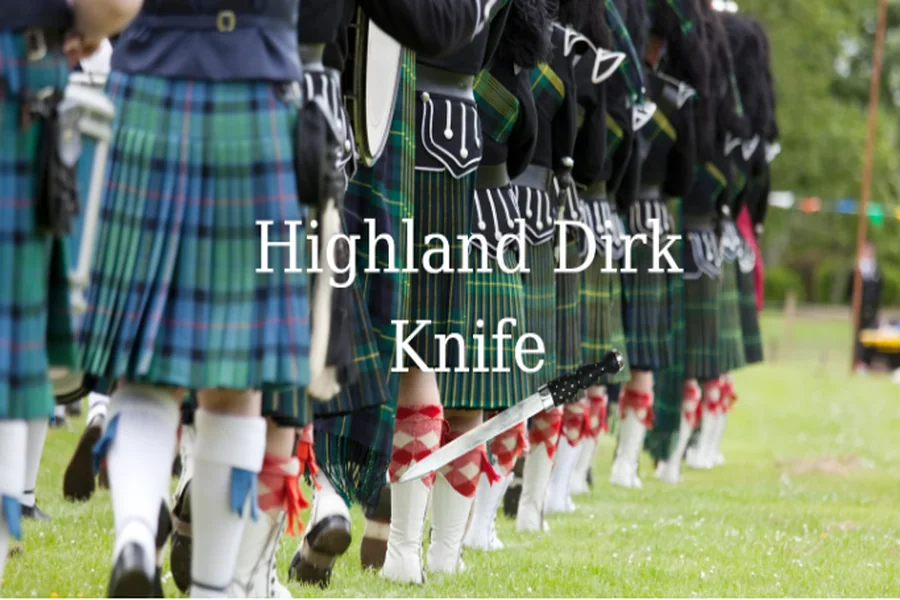
In the world of traditional Scottish arms, few objects carry the cultural weight and historical depth of the Highland dirk. More than a weapon, the dirk functioned as a marker of status, loyalty, and personal honor among Highland warriors. Today, historically faithful examples such as these Scottish Highland dirk knives preserve a lineage that reaches back centuries into the martial culture of the Gaels.
Origins of the Highland Dirk
The dirk emerged in the late medieval period as a long-bladed thrusting knife, influenced by continental daggers yet shaped by the realities of Highland warfare. Its name likely derives from the Gaelic biodag or the earlier Scots term dorge, evolving into “dirk” by the 17th century. By that time, it had become an essential companion to the basket-hilted broadsword and targe carried by Highland fighting men.
Unlike shorter utility knives, the dirk was purpose-built for close combat. Its long, narrow blade allowed decisive thrusts, especially once swordplay collapsed into grappling range. In battle, the dirk was not a secondary afterthought but a final, trusted instrument.
Role in Highland Society and Warfare
Within the clan system of the Scottish Highlands, arms carried deep symbolic meaning. The dirk was worn openly, usually suspended at the right side, signaling both readiness and social standing. To be armed was to be free; to be disarmed was a mark of submission.
During the Jacobite era, particularly in the uprisings of 1715 and 1745, the dirk became inseparable from the image of the Highland warrior. Contemporary accounts describe its use in the chaos following a charge, when muskets were spent and swords locked. After the Battle of Culloden, the British government recognized this symbolism all too clearly.
Prohibition and Survival
Following the defeat of the Jacobites in 1746, the Act of Proscription banned traditional Highland dress and arms. Dirk, sword, and targe were explicitly forbidden. While many blades were confiscated or destroyed, others were hidden, passed down quietly within families, or later adapted into dress dirks when restrictions eased.
By the 19th century, the dirk experienced a transformation. It re-emerged as a ceremonial object, worn with full Highland dress by officers and later by pipers. Decorative hilts, carved grips, silver mounts, and elaborate sheaths replaced purely martial designs, yet the historical form remained unmistakable.
Craftsmanship and Materials
Traditional Highland dirks feature straight or slightly curved blades, often single-edged with a reinforced spine. Earlier examples favored simplicity and strength, while later ceremonial dirks incorporated fine engraving and symbolic motifs.
Handles were commonly carved from hardwood, horn, or bog oak, sometimes in basket-weave patterns echoing sword hilts. The sheath often included smaller companion knives, known as the by-knife and skian, reinforcing the dirk’s role as a complete fighting and utility system.
Authentic modern reproductions closely follow these established forms, respecting historical proportions and materials rather than reimagining them for novelty.
The Dirk as Cultural Legacy
Today, the Highland dirk stands as a tangible link to a period when arms were inseparable from identity. It tells a story of resistance, adaptation, and survival in the face of cultural suppression. Whether displayed as an heirloom, worn as part of formal Highland dress, or studied as a historical artifact, the dirk remains one of the clearest expressions of Scottish martial heritage.
In preserving and understanding the Highland dirk, we preserve more than a blade. We preserve the memory of a people for whom honor, loyalty, and tradition were carried quite literally at their side.
