

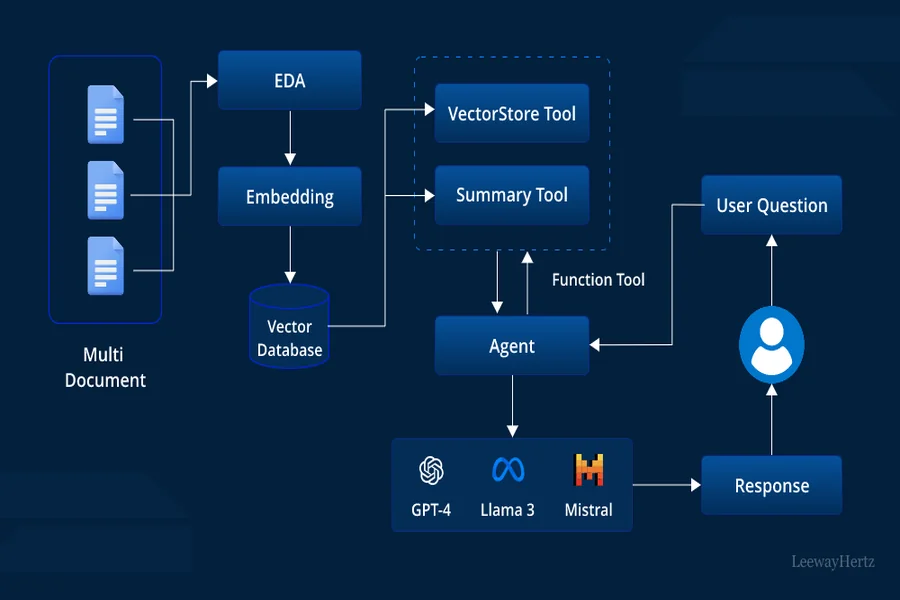
In the world of business technology, AI is no longer just a fun tool to play with. It is actually a fundamental element of the way organizations function. Two major concepts that are driving this transformation are RAG and Agentic RAG. Although they sound similar, they perform very different functions in terms of AI automation.
In this post, you will learn how these two models operate and the reasons why the transition from merely searching to making intelligent decisions matters for your business.
What is RAG?
RAG stands for Retrieval-Augmented Generation. Simply put, it is a method of providing an AI model with a collection of your company’s confidential data.
Normally, an AI is only aware of the information it was trained on. As a result, it may not be familiar with your most recent products or your particular company policies. After you ask it a question, the system first goes through your documents, fetches the relevant information, and then uses that information to generate a response.
How RAG works
- You pose a question.
- The system scans your data. Essentially, it looks for files, PDFs, or spreadsheets that contain the information related to your query.
- The AI analyzes the results and uses the retrieved information to generate a response.
- It presents an answer. The answer is based on your actual data, which makes it more reliable.
This model does very well for straightforward situations. For instance, if a worker inquires about the company’s policy on remote work, RAG can locate the HR handbook and provide a concise summary.
What is Agentic RAG?
Traditional RAG is like a librarian who locates a book for you. Agentic RAG, on the other hand, is like a smart assistant that reads the book, reflects on it, and then does the work for you.
In RAG vs Agentic RAG, the key difference is the ability to act. Agentic RAG uses an agent, a piece of software that can plan steps, use different tools, and check its own work.
How Agentic RAG works
- Planning: The agent comes up with a plan of action and decides how to approach the problem instead of just performing a search.
- Multi-step search: It may first examine your sales data, then check the web for market trends, and finally look at your inventory. It doesn’t give up after one search.
- Reasoning: It reviews all the collected data and determines what it means.
- Taking Action: It has the capability to carry out tasks, like sending an email, updating a database, or marking an order for review.
Why Agentic RAG is Better for AI Automation
Usually, in a real office, very few jobs are only about answering a single question. Most of them consist of multiple steps and involve different types of software. That is the point where AI automation excels.
Solving Complex Queries
For a simple RAG system, a request like, “Look at our last three months of sales and tell me if we should increase our stock of blue shirts,” would be very difficult to handle.
A traditional RAG might locate the sales figures, but it will not be able to figure out how to compare them with your current stock levels or anticipated trends. An agentic system would do the following:
- Get the sales report.
- Get the current inventory list.
- Find out if there are any holidays or promotions coming up.
- Make a comparison of all the data and provide a recommendation.
Reducing Mistakes
Basic AI sometimes invents content to fill in gaps. Since Agentic RAG includes mechanisms to assess the accuracy of its own results, the chances that it will deliver misleading information are considerably reduced.
Connecting Your Systems
Businesses today utilize a variety of applications such as Slack, Salesforce, email, and cloud storage. Agentic RAG may serve as a connector. It can extract a user’s profile from CRM, prepare a brief on their last three email exchanges, and then write a response that addresses the problem at hand very effectively.
Real-World Use Cases
Customer Support
- RAG: A chatbot that answers questions about return policies by reading a manual.
- Agentic RAG: A bot that looks up a customer’s order, checks the shipping status, realizes the package is lost, and offers a refund or a new shipment automatically.
Legal and Compliance
- RAG: Finding a specific clause in a 100-page contract.
- Agentic RAG: Comparing a new contract against company standards, highlighting risky parts, and suggesting better wording based on past legal wins.
Financial Planning
- RAG: Finding the profit margin from last year’s report.
- Agentic RAG: Analyzing spending patterns across all departments and suggesting where to cut costs to meet next year’s budget goals.
Which One Should Your Enterprise Choose?
Deciding between these two comes down to what you want to achieve.
Opt for Traditional RAG if:
- Your main requirement is an improved way for employees to search internal documents.
- You would like a straightforward FAQ bot on your website.
- Your budget is quite constrained, and you need a fast deployment.
Opt for Agentic RAG if:
- Your goal is to automate entire workflows, not merely answer questions.
- Most of your work necessitates extracting data from various sources.
- It is important that, when necessary, the AI can make the final decision independently, and the level of accuracy in such situations ought to be very high.
The Future of AI in the Workplace
The boundary between humans and AI assistants is going to be even more difficult to distinguish in the future. We are moving toward an era where AI not only helps us discover facts but also assists us in deciding on our actions based on those facts.
Upgrading from RAG to Agentic RAG is like moving from a mere digital library to a full digital teammate.
