

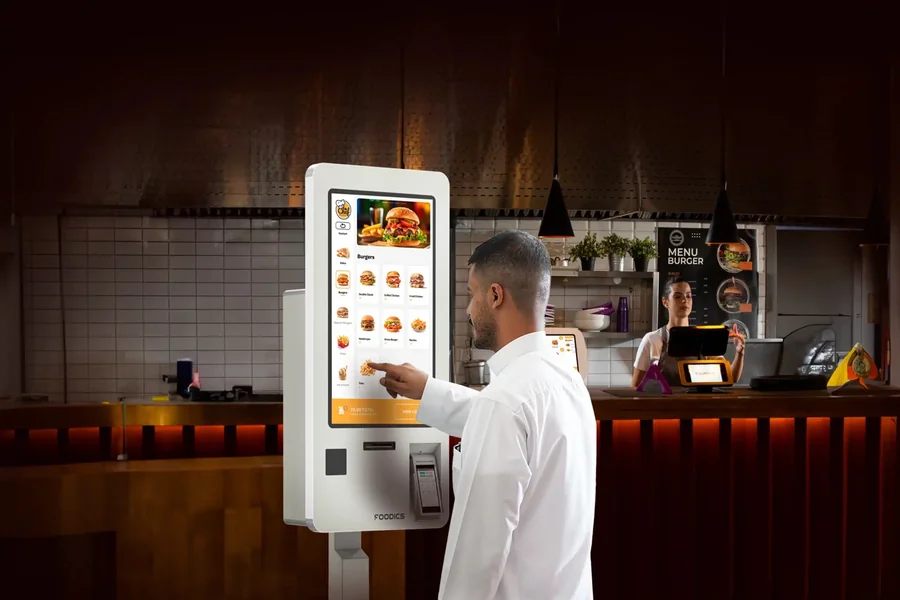
Walk into almost any bustling café, busy food court, or fast-moving quick service restaurant, and you’ll notice something different about how customers place their orders. Customers aren’t always lining up at the counter or waving down staff; they’re tapping through menus on sleek screens, paying in seconds, and collecting their meals without the usual wait-time frustrations.
This shift is no accident. The rise of the self-service kiosk POS system has transformed how modern food businesses operate. What started as a novelty in fast-food chains has now become a mainstream expectation across hospitality. The combination of speed, accuracy, and customer autonomy is too valuable to ignore.
But the real power of self-service kiosks becomes clear when you look closely at how they’re used in different environments. Cafés, food courts, and quick-service restaurants each reap unique benefits from kiosk technology tailored to their pace, customer behaviour, and operational demands.
Below, we explore the most impactful use cases in each setting and why kiosks are becoming a must-have tool for food businesses looking to scale smartly.
1. The Quick Service Restaurant (QSR) Powerhouse
QSRs are the poster children of kiosk success, as their business model depends on speed and consistency.
The Kiosk Advantage:
- Line-Busting Ability: Unlike a single human cashier being the only bottleneck, four kiosks enable four customers to place and pay for their orders simultaneously. This parallel processing can shorten queue time by up to 50%, especially during the lunchtime rush. Sales are made, not lost to impatient customers who turn and walk away.
- The Unforgettable Upseller: There is no way a kiosk can forget to upsell. When a client orders a burger, the computer programme will automatically offer high-profit add-ons such as premium sides, cold beverages, or desserts, frequently with alluring, high-resolution images.
- Pinpoint Accuracy: Orders are entered directly by the customer, so miscommunication cannot occur due to a noisy environment or a rushed cashier. The resulting almost-perfect order accuracy reduces food waste and unnecessary remakes, thereby safeguarding your food cost percentage.
Use Case Six: A fast-food chain has six self-service kiosks. During their peak hours, they can process more than 100 transactions per hour, and the staff are focused on production and delivery rather than order entry.
2. Cafes and Bakeries: Handling the Morning Rush
The problem in cafes, especially in city centres, is that rush hour is hefty and concentrated, and there is a strong need for a fast, efficient morning routine. The self-service kiosk POS system is the ideal assistant for the barista.
The Kiosk Advantage:
- Complicated Customisation Made Simple: Coffee orders are also known to be very complicated (e.g., “Decaf oat latte or extra shot). The kiosk enables its customers to use these modifiers with the accuracy shown on the screen, so the order passed to the barista is absolutely clear. This helps minimise friction and errors that may even stall the entire service line.
- Staff Reallocation: With the transfer of the transactional load (taking the order and executing the payment) to the kiosk, cafe staff will have more time to focus on coffee-making, food preparation, and offering authentic, personalised service to guests who require or have questions.
- Loyalty and Data Capture: Built-in kiosks are also useful for registering loyalty programmes and tracking. Customers would find it easy to enter their information or scan a code to earn and redeem their points, and this would provide the valuable data that can be used by the cafe when targeting its marketing, e.g., “Your favourite pastry is on special today!”
Use Case: A busy free-standing cafe is utilising a wall-mounted kiosk to take morning orders during take-away. Orders are placed and payments are made immediately, and customers are identified by phone number to collect their orders, keeping the counter clean and the queue moving fast.
3. Food Courts: The Centralised Command Centre
Food courts pose unique challenges: high foot traffic, multiple vendors, and customers often ordering from several places at once. The self service kiosk POS system is the key to bringing order to the chaos.
Homeowners looking to upgrade their kitchens don’t always need a full renovation. Smart kitchen remodel alternatives for Texas homes can deliver impressive results without the high cost or long timelines. Simple changes like cabinet refacing, updated lighting, modern backsplashes, or new countertops can refresh the entire space.
The Kiosk Advantage:
- Centralised Ordering for Multi-Vendor Sites: Some advanced systems allow customers to browse menus from multiple food court vendors at a single kiosk. They can place a single consolidated order, which is then routed to the correct Kitchen Display Systems (KDS) for each vendor. This elevates the customer experience by simplifying the process.
- Language and Accessibility: Kiosks can be programmed to switch instantly between multiple languages, catering to the diverse traffic often found in metropolitan food courts and tourist areas. This inclusivity ensures that everyone can order accurately.
- Visual Appeal and Menu Management: Kiosks offer a clean, visually appealing platform to showcase vendor offerings, often more attractive than printed menus or small counter displays. Operators can instantly adjust prices or mark items as ‘sold out’ from a central dashboard, keeping all menus up to date across the entire court.
Use Case: A large mall food court installs ten central kiosks. The average perceived wait time for customers drops significantly because they can place their order instantly, then relax while waiting for the “ready” notification, often displayed on a digital screen linked to the POS system.
Why the Self Service Kiosk POS System is a Must-Have
The core reason for the massive adoption of the self service kiosk POS system is its ability to deliver superior performance on three business-critical metrics:
- Increased Revenue: Driven by powerful, consistent upselling and the ability to serve more customers per hour.
- Operational Efficiency: Achieved by reallocating staff from repetitive order-taking to higher-value roles, and dramatically reducing errors.
- Enhanced Customer Control: Customers get to browse without pressure, customise exactly what they want, and pay securely and quickly, leading to higher satisfaction and repeat visits.
For any quick-service business looking to thrive in a market that demands speed and service, the integrated kiosk is no longer optional; it’s the smartest investment you can make to secure a profitable future.
