

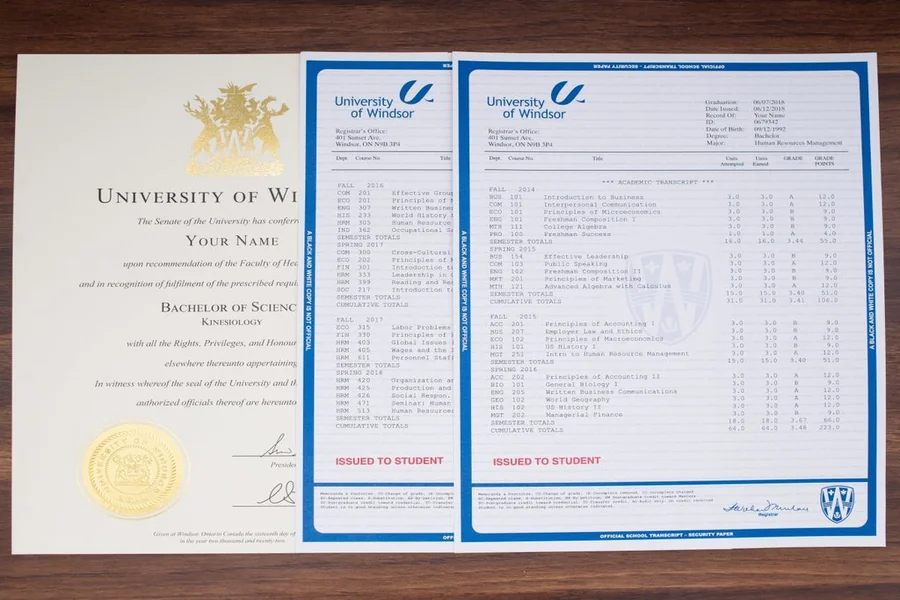
Missing academic records aren’t just annoying. They can really hold you up when you’re trying to move forward in your career, get a license, or apply for more education.
There are plenty of reasons these records vanish. Schools close. Disasters happen. Data gets lost during transfers. Or someone just misplaces the documents. Either way, you end up without the transcripts or diplomas you need.
The key is to handle it the right way. With a structured and honest approach, you can rebuild your records efficiently. This guide shares practical strategies that help you do exactly that.
Order a Professional Replacement Diploma
Losing your diploma or having it ruined is frustrating. One of the easiest fixes is ordering a replacement from a professional diploma maker. These services focus on making documents that are almost identical to the real thing — matching the typography, seal, signatures, and paper quality of your original school.
You’ll normally need to provide proof that you actually graduated or attended, which helps maintain proper standards.
This option is particularly valuable when the original institution no longer operates or charges prohibitive fees for duplicate issuance.
Initiate Official Transcript Requests from the Source
Start simple: contact the school directly and request your official transcripts from them. It’s usually the quickest and most reliable way.
Accredited institutions tend to keep student records for many years. Some have modern digital systems, others still use older storage methods. Head to the registrar’s office – they’re in charge of these documents.
Share whatever information you have left: your old student ID, the years you studied there, or any other details. Many schools now offer online ordering through services like Parchment or the National Student Clearinghouse, so you can often get electronic copies quite fast – sometimes in just a day or two.
If your old school merged with another, the new institution should have your records. That’s usually the easiest case.
But what if the school closed down entirely? Then contact your state department of education. They can tell you where the records went or who to ask next.
Also, track what you do. Write down the date of every call and email. Note any reference numbers. And get the names of whoever you talk to. That way, you’ve got a clear paper trail if you need it later.
Contact State or National Archival Authorities
If you asked the school or college directly and got nowhere, go up a level.
Every state’s Department of Education keeps information on schools that closed or got consolidated. They can usually tell you where to look for missing records. Some states even have a designated “custodian of records” just for handling documents from defunct institutions.
Nationally, the National Student Clearinghouse is a great resource for postsecondary records in the United States. In the UK, the General Register Office often holds the key to older educational histories.
And for K-12 records? The school district’s main administrative office is frequently the best bet. They tend to keep central student files long after individual schools shut their doors.
Remember to provide a signed authorization form with your request. Give them as much information as possible, including your entire name back then, year of birth, estimated years of attendance, and any particular names of instructors or principals that spring to memory. It definitely helps.
Reconstruct via Third-Party Verification
If official records cannot be retrieved, build a supporting portfolio of third-party evidence that collectively verifies your academic history. Acceptable documents include:
- Tax returns that list educational institution names and years of enrollment (e.g., tuition deduction forms)
- Official test score reports (SAT, ACT, GRE, GMAT, AP exams) that were sent to the institution
- Military service records that list education for rank placement
- Employment background checks where prior verification confirmed your degree
- Course syllabi, graded assignments, or correspondence with professors
- Yearbook photographs with timestamps and school insignia
- Bank or scholarship award letters referencing your enrollment status
Once you have everything, put it all into a notarized affidavit. Write out a clear explanation of how your original records were lost. Some employers, licensing boards, and graduate programs will accept this kind of portfolio on a provisional basis.
That’s especially true if you also include a signed statement from a former academic advisor or dean who can personally confirm you attended.
Pursue a Credential Evaluation or Equivalency Determination
Do not give up if your original academic records, such as degrees, transcripts, or diplomas, are lost forever or cannot be recovered. There are still opportunities for you to further your profession and justify your education. Here are two main paths to think about.
Foreign Credential Evaluation
In many situations, a foreign credential review is the easiest option. Missing original papers are a common problem for organizations like WES, ECE, and SpanTran.
Alternative papers like official statements from your institution, evidence of payment, course descriptions, or a signed declaration outlining your educational experience and the reason the originals are not accessible are frequently accepted.
Ultimately, American and Canadian organizations and businesses accept the assessment report they offer as a valid substitute for your misplaced paperwork.
U.S. Equivalency or Proficiency Exams
Sometimes a full credential evaluation just isn’t possible. In that case, you can still prove your education is equivalent to U.S. levels by passing certain standardized tests.
If you’re aiming for high school equivalency, the GED or HiSET exams are the way to go. They show that you have the same skills and knowledge as a typical American high school graduate.
For college credit, CLEP and DSST exams are great options. They let you test out of subjects you’ve already mastered instead of taking the full course.
Best part? Most colleges, vocational programs, and employers accept these credentials without any issues.
Professional Licensing: The Declaratory Order and Other Exceptions
Applying for a professional license can feel pretty rigid at times, especially in fields like law, medicine, engineering, or real estate. The good news is that many state boards offer something called a declaratory order. It’s essentially a formal way to prove your qualifications using evidence that doesn’t always follow the usual path.
This often includes things like:
- Years of hands-on work experience backed up by supervisor letters or performance records
- Completed continuing education courses, workshops, and seminars
- Successfully passing the required licensing examinatio
Interestingly, there are rare cases where boards have bent the rules a bit. One example is letting someone sit for the bar exam without submitting complete law school transcripts — provided they could demonstrate strong legal knowledge in other ways.
Why This Effort Is Worthwhile
Pursuing any of these options will take more time, patience, and paperwork than simply presenting original documents. However, the long-term benefits are significant:
- You gain a solid, official baseline credential that is recognized by institutions and employers.
- This new credential stays with you permanently—unlike lost originals, it can be stored digitally and retrieved easily.
- You reopen doors to higher education, better job opportunities, and professional advancement that might otherwise remain closed.
Ultimately, while the process may feel daunting, it offers a legitimate and durable path forward when your primary documents have disappeared.
Contact Alumni Networks and Former Faculty
People you know can often get you answers faster than anything else, even if it’s easy to forget that. Try alumni groups, old Facebook pages for your school, or LinkedIn communities for former students. You might find classmates who kept their own records—transcripts, grade reports, or graduation programs.
Former faculty and administrative staff can be especially helpful. Many held onto personal copies of grade lists, advising notes, or departmental archives. Sometimes, a long-serving registrar or associate dean kept backup files or old hard drives after the institution shut down.
When you get in touch, be professional and to the point. Share your situation briefly, offer to sign any necessary privacy forms, and thank them for their time. There are actually documented cases where retired registrars had entire sets of student records stored at home and were able to provide official notarized verification letters.
Use Government and Accreditor Interventions
If nothing else has worked, your next step is to contact the school’s accreditor or the proper government office.
These accrediting organizations — think HLC, WASC, or SACSCOC — normally insist that any closed institution provide a teach-out plan and a clear location for storing student records. When a school has broken records-retention laws, the accreditor can step in and push the record custodian to release the documents. Sometimes they’ll even provide an official verification letter themselves.
Another solid option is reaching out to your state attorney general or the Federal Trade Commission. This route has helped quite a few students from for-profit colleges that shut down without warning, especially when federal financial aid was involved. It does take time and paperwork, but it often gets results.
Prevent Future Loss: Digitize and Distribute
After you’ve rebuilt your records, take a few minutes to set up a solid backup system. This step prevents future headaches.
Start by digitizing every document at 300 DPI or higher. Then store the files in three separate locations:
- A secure cloud service (Google Drive or Dropbox with two-factor authentication)
- An encrypted external hard drive
- A fireproof safe at home
It’s also a good idea to give sealed copies of your key transcripts and diploma to your employer, professional association, and one reliable family member.
Finally, register your credentials with a trusted digital service such as the National Student Clearinghouse’s Degree Verify or a blockchain-based system like Blockcerts. These platforms give instant, secure verification to anyone who needs it — without you having to hunt down physical copies ever again.
Conclusion
It’s often not as complicated as it seems to rebuild missing academic records. The best place to begin is usually the registrar at your old institution. If they don’t have what you need, try contacting state or national archival offices next.
You’ll also want to collect any third-party documents that might support your case—tax records, test results, military papers, that kind of thing. Sometimes, a credential evaluation service or an equivalency exam can fill in the gaps. And it doesn’t hurt to reach out to alumni networks or former instructors; they occasionally provide helpful confirmation.
If nothing else works, consider filing formal requests with accreditors or government agencies. Once everything is back in hand, digitize the documents and store backups in safe locations. In most situations, this approach gets the job done.
