

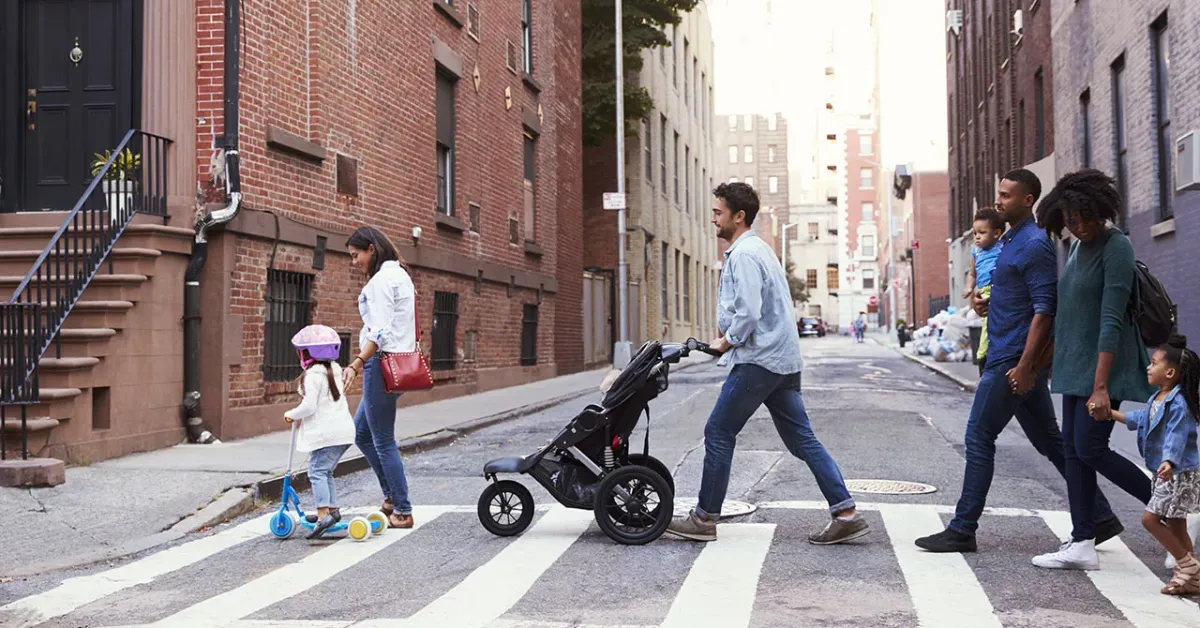
For many American families, neighborhood streets no longer feel as safe as they once did.
A new study conducted by Jones and Swanson examined the growing dangers children face from speeding vehicles in residential areas and found that risks extend far beyond major highways and busy intersections. In many cases, the greatest threats now exist directly outside children’s homes, schools, parks, and playgrounds.
The research arrives amid a larger national increase in pedestrian fatalities that has transformed roadway safety into a growing parental concern.
Children face distinct dangers as pedestrians because they process traffic differently than adults. Younger children often struggle to estimate vehicle speed, identify safe crossing opportunities, or predict driver behavior. Their smaller size also makes them harder for motorists to see, especially around parked cars or large SUVs.
Neighborhood environments that appear safe on the surface can quickly become dangerous when speeding vehicles are introduced.
The study identified residential roads, intersections, school zones, sidewalks, and driveways as recurring locations where children face elevated injury risks. While highways receive much of the public attention surrounding traffic fatalities, local roads create daily exposure for children simply moving through their own communities.
For parents, the consequences extend beyond crash statistics.
Concerns about speeding traffic increasingly shape how families allow children to interact with their neighborhoods. In many communities, parents report limiting outdoor play, restricting independent walking or biking, and increasing supervision due to fears surrounding vehicle traffic.
Researchers studying neighborhood safety have long found that community violence and traffic danger can significantly alter childhood behavior patterns. Families in higher-risk environments often keep children indoors more frequently or avoid neighborhood parks and sidewalks altogether.
Traffic danger can therefore affect not only physical safety but also childhood independence, outdoor activity, and community interaction.
The problem is particularly acute near schools.
School zones combine some of the highest concentrations of child pedestrians with some of the most chaotic traffic conditions. Parents rushing through drop-off lines, distracted drivers checking phones, illegal passing, speeding, and congested intersections all contribute to increased risks during school commute hours.
Many school zones also rely heavily on signage and painted markings rather than physical roadway protections capable of forcing slower speeds.
The study further notes that many drivers underestimate the severity of residential speeding because neighborhood roads feel familiar. Familiarity often lowers perceived risk, leading drivers to pay less attention or drive faster than conditions safely allow.
Yet residential streets are precisely where children are most likely to appear unpredictably.
A child chasing a ball, stepping off a curb, exiting between parked vehicles, or riding a bicycle near a driveway may give drivers only seconds to react. At higher speeds, reaction times and stopping distances shrink dramatically.
Vehicle trends have also changed the equation for parents.
The increasing popularity of SUVs and pickup trucks has raised new concerns because these vehicles create larger blind zones and often cause more severe pedestrian injuries during impacts. Children standing directly in front of some larger vehicles may remain completely invisible to the driver.
Driveways present another overlooked risk.
Many low-speed backover incidents involving children happen in residential driveways, often involving family members or neighbors who do not realize a child is behind the vehicle. Safety experts increasingly encourage families to treat driveways with the same caution as active roadways.
The broader findings suggest child pedestrian safety is no longer solely an issue of individual driver responsibility. Community design, traffic engineering, vehicle size trends, and local driving culture all contribute to the environments children navigate daily.
Neighborhood speeding campaigns such as “Keep Kids Alive Drive 25” aim to address that culture by encouraging drivers to recognize that residential roads are shared spaces rather than extensions of commuter corridors.
The underlying message of the study is straightforward: small increases in neighborhood speed can carry life-altering consequences when children are nearby.
As pedestrian fatalities continue rising nationally, communities may increasingly face difficult questions about how residential streets should function — whether primarily as fast-moving traffic routes or as places where children can safely walk, bike, and play close to home.
