

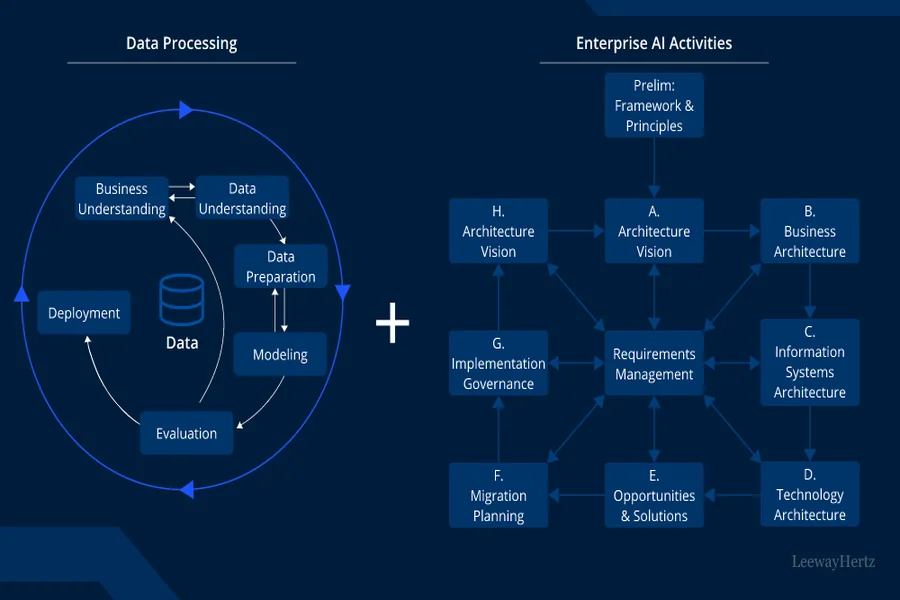
Machine learning is often introduced through small experiments — a model that predicts something useful, a dashboard that surfaces insights, a pilot that shows early promise.
But once a company tries to move beyond that stage, a different set of questions appears.
How does this system run every day?
Where does the data come from?
What happens when it stops performing well?
This is where architecture becomes the real focus.
Enterprise machine learning architecture isn’t about a single model. It’s about everything required to make that model function reliably inside a business.
Why Architecture Becomes the Real Challenge
At a small scale, machine learning can feel manageable.
A team trains a model, tests it, and deploys it in a controlled way. But enterprise environments are rarely controlled. Data changes. Systems evolve. Requirements shift.
Without a structured foundation, even a well-performing model becomes difficult to maintain.
This is usually the point where teams start looking for machine learning development help — not just to improve accuracy, but to design systems that can actually operate under real conditions.
Because at the enterprise level, the problem is no longer “Can we build this?”
It becomes “Can we run this consistently?”
The Core Layers of Enterprise ML Architecture
While implementations differ, most enterprise setups follow a similar structure. Not because it’s theoretical, but because these layers solve practical problems that appear in almost every project.
1. Data Layer
Everything starts here.
Enterprise systems pull data from multiple sources:
- Internal databases
- APIs
- Logs and event streams
- Third-party tools
The challenge isn’t access — it’s consistency.
Data needs to be:
- Clean enough to use
- Structured in a predictable way
- Updated regularly
Without this, everything downstream becomes unstable.
2. Data Processing and Feature Engineering
Raw data is rarely usable as-is.
It needs to be transformed into something models can understand:
- Aggregated
- Normalized
- Enriched with context
This step often takes more effort than model building itself.
And in enterprise environments, it has to run continuously — not just once.
3. Model Development
This is the part most people focus on, but it’s only one piece.
Here, teams:
- Select algorithms
- Train models
- Validate performance
At this stage, results can look strong. But they’re still isolated from real-world conditions.
4. Deployment Layer
Moving a model into production introduces new complexity.
The system must:
- Handle real-time or batch inputs
- Respond within acceptable timeframes
- Integrate with existing applications
This is where many projects slow down. What worked in testing doesn’t always translate directly.
5. Monitoring and Maintenance
Once deployed, the work isn’t finished.
Models can degrade over time due to:
- Changes in data patterns
- Shifts in user behavior
- External factors
Enterprise architecture includes monitoring systems that:
- Track performance
- Detect anomalies
- Trigger retraining when needed
Without this layer, models quietly become less reliable.
Why Scaling Changes Everything
At a smaller scale, some of these steps can be handled manually.
At an enterprise level, that’s no longer possible.
Systems must:
- Process large volumes of data
- Operate continuously
- Handle failures without disruption
This requires automation across the entire pipeline — not just in model execution.
Scaling isn’t just about handling more data. It’s about maintaining stability as complexity increases.
Integration Into Business Systems
Even a well-designed ML system has limited value if it operates in isolation.
Enterprise architecture connects models to real workflows:
- CRM systems
- Operational tools
- Decision-making platforms
For example:
- A prediction feeds directly into a sales workflow
- A risk score influences approval processes
- A recommendation updates inventory decisions
Without this connection, outputs remain unused.
The Importance of Consistency
One of the less visible challenges in enterprise ML is consistency.
Different teams may:
- Use different data definitions
- Build separate models for similar problems
- Follow different processes
Over time, this creates fragmentation.
Architecture helps standardize:
- How data is handled
- How models are deployed
- How results are interpreted
This doesn’t remove flexibility, but it prevents systems from drifting apart.
Common Mistakes in Enterprise ML Architecture
Even with good intentions, certain issues appear frequently:
Overcomplicating the System
Teams sometimes design for every possible scenario upfront. This creates unnecessary complexity and slows development.
Ignoring Data Quality
Focusing too much on models while neglecting data leads to unstable systems.
Treating Deployment as the Final Step
In reality, deployment is the beginning of a longer lifecycle.
Lack of Ownership
Without clear responsibility, systems degrade over time.
Build vs Structure
Many organizations focus on building models, but fewer focus on structuring how those models live inside the business.
That difference matters.
A model can work technically but fail operationally.
Architecture is what connects those two sides.
How Enterprise ML Matures Over Time
Enterprise machine learning doesn’t appear fully formed.
It evolves.
Early stages often look like:
- Isolated experiments
- Manual processes
- Limited integration
Over time, systems become:
- More automated
- Better integrated
- Easier to maintain
The goal isn’t perfection. It’s stability.
Final Thought
Enterprise machine learning architecture isn’t about choosing the right tool or building the most accurate model.
It’s about creating a system that can operate under real conditions — consistently, reliably, and at scale.
That means thinking beyond individual components and focusing on how everything connects:
data, models, processes, and people.
Because in the end, success isn’t defined by what a model can do once.
It’s defined by whether it keeps working when everything around it changes.
